


Spirit of 76 (part 2): 5 Fun Facts About Gemini 6A

Updated: May 27
☆ Check out Spaceflight Histories on YouTube ☆
December 15, 2025 was the 60th anniversary of Gemini 6A, the fifth manned flight of the Gemini program. The mission's command pilot was Walter M. Schirra, the fifth American in space (not counting the X-15 pilots) and veteran of Mercury-Atlas 8. The pilot was rookie Thomas P. Stafford, commander of three future missions including a flight to the moon. The crew's backup astronauts were Gemini 3 veterans Virgil I. "Gus" Grissom and John W. Young. Let's look at five interesting facts about Gemini 6A.


1. Your Flight Has Been Delayed
The original Gemini 6 mission plan was quite different from the mission that was realized. Schirra and Stafford were scheduled to launch on the fourth manned Gemini mission on October 25, 1965, and orbit the Earth 29 times. They were to dock with and undock from the Agena Target Vehicle four times. According to the Williamson Daily News from October 25, 1965, Gemini 6 would also attempt to observe a laser beam flashed from White Sands, New Mexico as the crew passed over. After 46 hours and 47 minutes in space, Gemini 6 would splash down in the west Atlantic Ocean south of the island of Bermuda.
An Atlas-Agena carrying the Agena Target Vehicle launched from Cape Kennedy's Launch Complex 14 on October 25 while Schirra and Stafford were in their spacecraft awaiting liftoff from Pad 19. The Atlas booster performed nominally but when the Agena's engine fired to separate it from the booster for orbital insertion, it exploded. Range Safety at Cape Kennedy tracked numerous pieces of debris as they plummeted into the Atlantic Ocean and Gemini 6's launch was called off.
NASA decided to go ahead with launching Gemini 7 in early December and gave Gemini 6 a new designation and objective: Gemini 6A would launch eight days after Gemini 7 and the two would perform the first rendezvous of two spacecraft in orbit. Gemini 7 launched on December 4 to set a new manned space endurance record.
The first successful Agena Target Vehicle launched on March 16, 1966 for docking with Gemini 8.

2. Patch Me Through
Gemini 6(A)'s mission insignia is shaped like a hexagon to represent the mission's number. The original design showcased Gemini 6's original objective of rendezvousing with the Agena: At the top of the patch was "GTA-6" for Gemini-Titan-Agena and a large Arabic numeral "6" as the stylized spacecraft trajectory. Within the Gemini spacecraft are the twin stars Castor and Pollux of the constellation Gemini, and the cylindrical object beneath the capsule is the Agena. According to Schirra in the 1985 book All We Did was Fly to the Moon by Dick Lattimer, the spacecraft are placed in the sixth hour of celestial right ascension—in the constellation Orion—where rendezvous was predicted to take place.
When Gemini 6 turned into Gemini 6A, "GTA-6" was replaced with simply "Gemini 6" and the Agena was replaced with another Gemini capsule to represent the new mission's primary objective.
GTA-6 patch and Gemini 6 patch modern reproduction (NASA)
3. Your Flight Has Been Delayed...Again
On the morning of December 12, Schirra and Stafford strapped in to the seats of their Gemini spacecraft and waited for liftoff. At 9:54 AM Cape time, the Titan II booster's LR-87 engine ignited, but abruptly shut down 1.5 seconds later. The liftoff clock started but the rocket just sat on the pad. Mission rules dictated that since the onboard clock had started as if the vehicle had actually launched, command pilot Schirra was to pull the D-ring between his knees to fire the ejection seats and propel himself and Stafford away from the fully-fueled rocket. Unlike the Mercury and Apollo spacecraft, which used small solid-fueled rocket motors to pull the capsule away from the booster in the event of an emergency, the Gemini capsule was fitted with ejection seats like those used in military aircraft. Had the Titan II risen only a few inches and fallen back to the launch pad, it would have collapsed and exploded. Schirra, a steely-eyed test pilot and veteran astronaut, did not feel any movement and determined the rocket had in fact not lifted off. He did not abort.

This quick decision-making saved himself and Stafford, the spacecraft, and possibly the mission itself. To start, the ejection seats would subject the astronauts to 20 G's as they were hurled at least 800 feet (244 m) in the air to put distance between them and the Titan II and to give their parachutes enough time to open. Furthermore, the astronauts had been sitting in a pure oxygen environment for hours so had they gotten close to fire, they would have burned. In a 1997 oral history conducted by the Johnson Space Center, Stafford stated he and Schirra "would have been two Roman candles going out." It is likely the astronauts would not walk away uninjured, but even if they did not get injured, their spacecraft would need to be repaired, further delaying the mission. Gemini 7 would return from its two weeks in orbit before Gemini 6A had another shot at leaving the ground.

The pad crew had to wait more than an hour before retrieving Schirra and Stafford from their capsule since the Titan's first stage engines needed to shut down and a fire in the engine compartment caused by leaking fuel needed to be extinguished. According to a Smithsonian piece from 2020, "one of the Titan's umbilical plugs, which carried electrical signals to the launch equipment, had prematurely fallen out, triggering a shutdown" (Neufeld). Turns out the mission would have likely been aborted even without the faulty plug: Subsequent examination found that Engine 2 experienced thrust decay due to a plastic dust cover left inside a line of the gas generator during the engine's assembly months earlier. An automatic abort prior to liftoff would have been triggered by the detection of a loss of thrust during ignition.
The Titan II and launch pad were turned around in three days and Gemini 6A finally lifted off from LC-19 at Cape Kennedy on Wednesday, December 15, 1965 at 8:37 AM local time. As with Gemini 7, Alan Bean served as Cape CAPCOM while Charlie Bassett, Gene Cernan, and Elliot See communicated with Gemini 6A from Houston.

4. Jingle All the Way
Gemini 6A made first contact with Gemini 7 at T+ 3 hours and 15 minutes at a distance of 270 miles (434 km). Visual contact was made at T+ 5 hours and 4 minutes at a distance of 60 miles (96.5 km). Several more firings of Gemini 6A's thrusters put the spacecraft within 130 feet (40 m) of Gemini 7 and the world's first space rendezvous was achieved.

Over the next 4.5 hours, or three orbits, the two spacecraft flew in formation as far apart as 300 feet (91.4 m) and as close together as only 1 foot (3 m). The astronauts also made visual contact with each other through the windows. Schirra, Stafford, and Lovell were all graduates of the US Naval Academy while Borman was the lone West Point alumnus. The 1965 Army–Navy football game ended in a 7–7 tie on November 27, so Schirra and Stafford held up a sign that read "Beat Army" as a friendly jab at Borman. The spacecraft separated to a distance of about 10 miles (16.1 km) to prevent collision during the crews' sleep periods.

While Borman and Lovell still had three days before their homecoming, Schirra and Stafford prepared to return to Earth on December 16. Schirra was known within the astronaut corps as a jokester, pulling pranks or "gotchas" on fellow astronauts (and occasionally the press). Before reentry, he radioed to Gemini 7,

The "music" indicated in the mission transcript is a rendition of "Jingle Bells"—Schirra played the tune on an eight-note Hohner "Little Lady" harmonica and Stafford jingled some small bells. The bells are now in the possession of the Smithsonian National Air and Space Museum and the harmonica is on display with a few other of Schirra's items at the Heroes & Legends exhibit at the Kennedy Space Center Visitor Complex.
One of Gemini 6A's unintended legacies was the beginning of musical instruments being carried into space. Since 1978, acoustic guitars, saxophones, flutes, keyboards, and even bagpipes have been played in orbit. The most famous example of music performed in space, rivaled only by Gemini 6A's "Jingle Bells", is Canadian astronaut Chris Hadfield's rendition of David Bowie's 1969 hit "Space Oddity" shot and recorded onboard the International Space Station. At some point, possibly at the start of their second day in space, Schirra and Stafford received what we would now refer to as a wakeup call, though the practice of transmitting wakeup calls did not begin until Apollo 10. Singer Jack Jones recorded a short rendition of the broadway song "Hello, Dolly!" replacing "Dolly" with "Wally" and the rest of the lyrics with allusions to spaceflight [1].
On December 16, 1965, after completing 16 orbits in 25 hours and 16 minutes, Schirra and Stafford returned to Earth.
5. Go Navy
The original Gemini 6 mission splashdown was planned to be the first live broadcast of the splashdown of an American capsule. This was unaffected by the failure of the Agena Target Vehicle and the twice-delayed launch of Gemini 6(A) so on December 16, Intelsat I provided the first live coverage of a mission's conclusion. Launching on April 6, 1965, Intelsat I, nicknamed Early Bird, was the world's first commercial geosynchronous communications satellite. It was built for the Communications Satellite Corporation (COMSAT) and based on the Syncom spacecraft family, the first geosynchronous satellite (Syncom 2) and first geostationary satellite (Syncom 3). Intelsat I made the first international broadcast of a rocket launch, Gemini 4, in June 1965 and supported the broadcasting of Apollo 11 to the world. Its greatest contribution to communications was its participation in the 1967 TV program Our World, the first live multinational and multi-satellite broadcast.
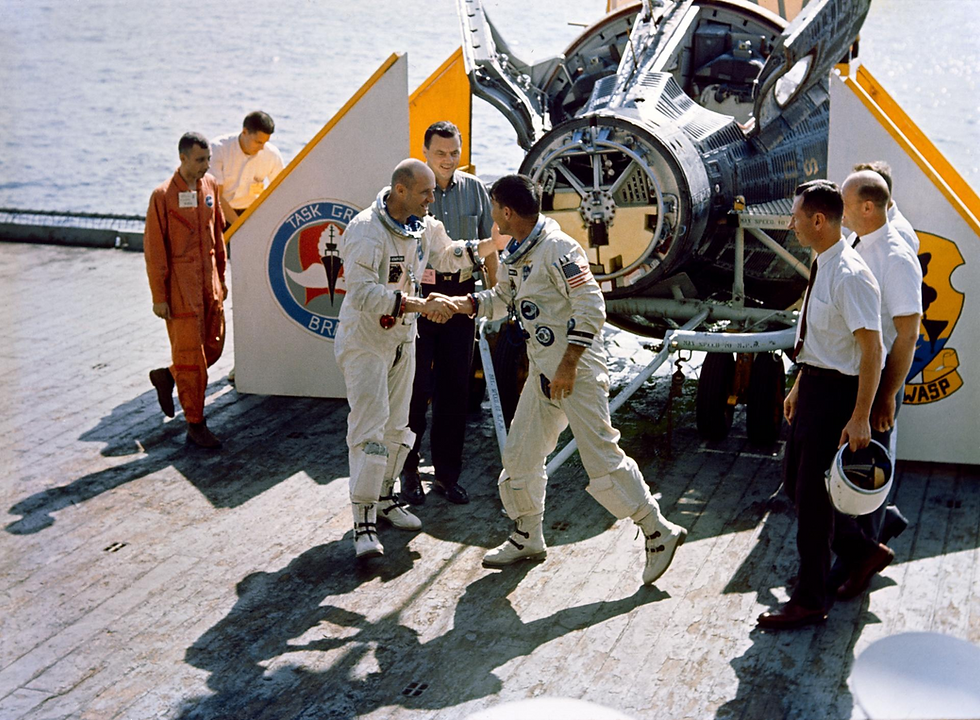
Intelsat I (NASA) | Navy frogmen help Schirra and Stafford out of their capsule (NASA ID: S65-61886)
Schirra and Stafford splashed down in the western Atlantic Ocean southeast of Cape Kennedy. Gemini 6A was the second manned spacecraft recovered by the USS Wasp (CV/CVA/CVS-18), an Essex-class aircraft carrier built during World War II. She was the tenth of eleven total Continental and US Navy ships to bear the name and received eight battle stars for her participation in several campaigns in the Pacific Theater, including the Battle of Philippine Sea, the Battle of Leyte Gulf, the Battle of Iwo Jima, and provided air support during the Battle of Guam. After modernization and service in the Atlantic, Caribbean, and Mediterranean, Wasp recovered five Gemini spacecraft—half of the program's manned flights. Gemini 4, Gemini 6A, Gemini 7, Gemini 9A, and Gemini 12 were all plucked from the ocean by the USS Wasp and her crew in 1965 and 1966. The ship was also a backup recovery vessel for Gordon Cooper and Mercury-Atlas 9 [2]. Wasp was decommissioned in 1972 and sold for scrap in 1973.
Gemini 6A's capsule is now on display at the Stafford Air and Space Museum in Weatherford, Oklahoma.

Post-Flight
Schirra and Stafford were reunited with Borman and Lovell at the Kennedy Space Center on December 19 and held their post-flight press conference at the Manned Spacecraft Center in Houston afterwards [3]. On Febaury 21, 1966, Wally and Jo Schirra and Frank and Susan Borman began a three-week eight-country goodwill tour. The two couples visited Japan, South Korea, Taiwan, Thailand, Malaysia, the Philippines, Australia, and New Zealand. They were oversees for the deaths of the original Gemini 9 astronauts (February 28) and for the Gemini 8 mission abort (March 17). Schirra traveled to Okinawa, Japan, where Gemini 8 astronauts Neil Armstrong and Dave Scott were brought to after recovery, and escorted them back to the Kennedy Space Center.

Wally Schirra commanded Apollo 7, the first manned mission of the Apollo program, in October 1968, during which he became the first person to make three trips into space. He retired from NASA and the US Navy in July 1969 with the rank of captain and joined Walter Cronkite as co-anchor on CBS News' coverage of the seven moon landing missions (including Apollo 13). Schirra worked in the private sector until the 1980s, authored multiple books about naval aviation and the early days of America's space program, and established the Astronaut Scholarship Foundation with the other Mercury astronauts and Gus Grissom's widow. He was inducted into the International Space Hall of Fame in 1981 and the US Astronaut Hall of Fame in 1990 as part of its inaugural group. Wally Schirra passed away on May 3, 2007 at the age of 84 from a heart attack and is the namesake of the USNS Wally Schirra, a Lewis and Clark-class dry cargo ship.


Tom Stafford flew in space another three times. In June 1966, he commanded Gemini 9A with Gene Cernan and rendezvoused with the Augmented Target Docking Adapter. In late 1966, Stafford was assigned as backup commander to the second Apollo mission with John Young, his Gemini 6A backup, as command module pilot and Cernan as lunar module pilot. The trio went on to orbit the moon as the crew of Apollo 10 in May 1969, testing the Apollo spacecraft in lunar orbit before Apollo 11 would attempt the first manned moon landing. Stafford and Cernan's closest approach to lunar surface in lunar module Snoopy was 9 miles (14.5 km) and during the crew's return to Earth set the record for the fastest speed traveled by a human being, a record that still stands more than 55 years later.

Stafford's final trip into space was as commander of the Apollo-Soyuz Test Project, the first docking of American and Soviet spacecraft that brought the official end to the Space Race in July 1975. American astronauts Stafford, Vance Brand, and Deke Slayton and Soviet cosmonauts Alexei Leonov (the first person to perform an EVA) and Valery Kubasov spent almost two days visiting each other's spacecraft, eating each other's food, and exchanging gifts. Stafford assumed command of the Air Force Flight Test Center at Edwards Air Force Base in California in November 1975 and initiated the development of the Lockheed F-117 Nighthawk, the AGM-129 Advanced Cruise Missile, and what would become the Northrop B-2 Spirit stealth bomber.
Stafford retired from the US Air Force with the rank of Lieutenant General in November 1979. In the 1990s, he served as an advisor for Space Station Freedom, the predecessor to the ISS, and for the Shuttle–Mir program. He was inducted into the International Space Hall of Fame in 1980 and the US Astronaut Hall of Fame in 1993. Tom Stafford passed away on March 18, 2024 at the age of 93 from liver cancer.
Gemini 6A and Gemini 7 accomplished the first rendezvous of two manned spacecraft in orbit, a critical maneuver for future manned moon landings, and prepared the second half of the Gemini program for learning and perfecting docking, working, and "walking" in space. While the final missions of 1965 ended smoothly, the same could not be said for the first mission of 1966.

[1] Unfortunately you probably won't be able to listen to it unless you make a trip to the Kennedy Space Center Visitor Complex. I've spent nearly 10 years searching for any record of it online and if not for the Chronology of Wakeup Calls published by the NASA History Division, you'd probably not believe me. Fortunately it is easy to find in person at KSC. Inside Heroes and Legends are exhibits named after different qualities astronauts have. The one titled "Principled" has Wally Schirra's flight jacket, harmonica, and a few other items. A touch screen gives you options to play short videos about a specific piece. I don't remember which, but one video will talk about Schirra's "gotchas". The song plays at the end of that.
[2] Cooper and Faith 7 were retrieved by the USS Kearsarge.
[3] It was on either December 23, 1965 or January 3, 1966. NASA has both dates listed for the same image.
Further reading
Uri, John. "Space Station 20th: Music on ISS." NASA Johnson Space Center, May 12, 2020. https://www.nasa.gov/history/space-station-20th-music-on-iss/
Bibliography
Caiella, J. M. "Two Navies, Three Names." U.S. Naval Institute, June 2023. https://www.usni.org/magazines/naval-history-magazine/2023/june/two-navies-three-names
Hacker, Barton C. and Grimwood, James M. "On the Shoulders of Titans: A History of Project Gemini." NASA, 1977. https://ntrs.nasa.gov/api/citations/19780012208/downloads/19780012208.pdf
Lattimer, Dick. All We Did was Fly to the Moon. Whispering Eagle Press, 1985.
Neufeld, Michael. "Failure to Launch: The Heart-Stopping Pad Shutdown of Gemini VI-A." Smithsonian, 12 December 2020. https://airandspace.si.edu/stories/editorial/heart-stopping-shutdown-gemini-vi
Stafford's official Johnson Space Center biography https://www.nasa.gov/wp-content/uploads/2016/01/stafford_thomas.pdf?emrc=077c78
Uri, John. "55 Years Ago: The Spirit of 76 – The First Rendezvous in Space." NASA Johnson Space Center, 8 December 2020. https://www.nasa.gov/history/55-years-ago-the-spirit-of-76-the-first-rendezvous-in-space/
This post was written entirely without the use of AI (sorry HAL). Go Cats!


Comments