


Eight Days or Bust: 5 Fun Facts About Gemini 5

Updated: Aug 20
☆ Rather watch a video than read all this? Click here to be redirected to my Gemini 5 YouTube video! ☆
August 21, 2025 is the 60th anniversary of the launch of Gemini 5, the third manned flight of the Gemini program and the longest manned space mission at the time. Two primary objectives were to spend eight days in orbit—the length of time it would take to fly to the moon, land on it, and return to Earth—and practice rendezvous maneuvers, a crucial component of future moon landing missions. Secondary objectives included evaluating the performance of the Gemini spacecraft's new fuel cells and performing a controlled capsule reentry to a predetermined landing spot. The astronauts would also carry out 17 defense-related, medical, and scientific experiments.
The prime and backup crews were named on February 8, 1965. The mission's command pilot was U.S. Air Force captain L. Gordon Cooper, the sixth American in space and veteran of Mercury-Atlas 9. The pilot was rookie U.S. Navy lieutenant Charles "Pete" Conrad of NASA's second class of astronauts, the New Nine. Rookies Neil A. Armstrong and Elliot M. See of the New Nine served as the backup command pilot and pilot, respectively. Let's look at five interesting facts about Gemini 5.

1. Patch Me Through
According to Leap of Faith by Gordon Cooper and Bruce Henderson, Cooper and Conrad wanted to name their capsule Lady Bird after the First Lady of the United States Lady Bird Johnson. However, NASA was very reluctant to allow astronauts to name their spacecraft after Gemini 3's Molly Brown and administrator James Webb turned down this request.
While the crews of Gemini 3 and Gemini 4 designed their own mission insignia that embellished silver medallions they carried into space, Gemini 5 was the first mission to feature embroidered patches. Cooper and Conrad, an Air Force test pilot and a Navy test pilot respectively, realized they had never been in a military or government organization without a patch symbolizing their mission or vehicle. Cooper's Mercury capsule, as well as all previous Mercury capsules, had simple but unique insignia painted on their exterior panels similar to nose art on aircraft.

The pair chose the image of a Conestoga wagon, a horse-drawn covered wagon used by American settlers in the 18th and 19th centuries, to represent the pioneering nature of Gemini 5. The mission's primary objective was orbiting the Earth for eight days, so the slogan "8 Days or Bust" was included in red letters across the wagon. However, Administrator Webb was concerned about the motto, writing in an August 14, 1965 memo, "I wish it could be omitted. If the flight does not go eight days, there are many who are going to say it was 'busted.'" A piece of cloth was sewn over the phrase prior to launch.
Legend has it the astronauts asked a local patch company to produce the patches and the two sewed them onto their spacesuits themselves. Cooper and Conrad waited until their pre-launch dinner party to tell Administrator Webb about the patches and he was quite unhappy. After they were able to convince him the insignia represented everyone working on the program, not just the two of them, he reluctantly allowed the patches to fly. After Gemini 5's success, Webb directed all future space crews to wear their own patch, internally referred to as a "Cooper patch", thus beginning one of the most cherished traditions in the space industry.


2. Eight Days A Week
Cooper and Conrad were awaiting liftoff on August 19 when thunderstorms and a lightning strike near the pad scrubbed the launch. The morning of launch, the pair ate the traditional breakfast of steak and eggs at the crew quarters at the Kennedy Space Center and suited-up in a trailer at Pad 16 on Cape Kennedy before a van drove them to their Gemini Titan II launch vehicle.
Gemini 5 launched from Launch Complex-19 at Cape Kennedy on Friday, August 21, 1965 at 9:59:59 AM EDT. Gemini 3 command pilot Gus Grissom served as Cape capsule communicator, or CAPCOM, while rookie Buzz Aldrin and Gemini 4 command pilot Jim McDivitt served as Houston CAPCOMs. The oxidizer tank of the Titan II rocket's first stage was retrieved from the Atlantic Ocean by USS Du Pont (DD-914) and is now on display at the US Space and Rocket Center in Huntsville, Alabama. The spacecraft entered an orbit of 101 miles x 216 miles (163 km x 349 km).
The Gemini spacecraft, due to the length of time it needed to operate in space, was the first spacecraft to use fuel cells to provide electrical power. Due to an issue with the fuel cells that cropped up during flight day 1, Gemini 5 could not rendezvous with the Rendezvous Evaluation Pod (see fun fact number 4). Flight day 2 was spent conducting experiments and taking pictures of Earth. On flight day 3, the crew performed a rendezvous with a "phantom" spacecraft and saw a Minuteman I missile launch from Vandenberg Air Force Base (AFB) in California.
At mission elapsed time 97 hours, 56 minutes, and 13 seconds, or after 4 days, 1 hour, 56 minutes, and 13 seconds in orbit, Gemini 5 broke the American manned space endurance record set by Gemini 4 in June 1965. Cooper and Conrad observed a rocket sled test as they flew over Holloman AFB in New Mexico, the ignition of another Minuteman missile and the contrail of its chase plane while over Vandenberg, and the USS Lake Champlain aircraft carrier in the Atlantic Ocean. On the morning of August 26, at mission elapsed time 119 hours and 8 minutes, or after 4 days, 23 hours, and 8 minutes in space, Gemini 5 officially became the longest crewed space mission to that point, surpassing the Soviet Vostok 5's record set in June 1963.
On flight day 5, one of the Gemini's orbit attitude and maneuvering system (OAMS) thruster blocks malfunctioned repeatedly and was shut off for good. 16 of the 17 planned medical, defense, and scientific experiments were carried out, including photography of celestial objects and zodiacal light, cloud-top spectrometry (including of tropical storm Doreen), photography of the Zagros Mountains in the Middle East, using a bungee cord for exercise, and eyesight tests. According to the NASA history publication On the Shoulders of Titans: A History of Project Gemini, Cooper captured the first photos of the light of the moonless sky. Pete Conrad wore leg cuffs that inflated for two out of every six minutes to help with blood circulation while in orbit. The one experiment not completed was photography of the Rendezvous Evaluation Pod.
As for the pioneering astronauts, they reported being cold, bored, and having trouble sleeping. They had to wear their G4C spacesuits the entirety of the mission and after eight days in space, the cabin was full of trash. Conrad would go on to call the mission "eight days in a garbage can". Aside from photography and their scheduled experiments, Cooper and Conrad made a special call to the ground, or the sea to be more precise. Former Mercury astronaut Scott Carpenter was spending 30 days in the Navy's Sealab II underwater habitat at a depth of 203 feet (62 m)off the coast of La Jolla, California. The astronauts briefly talked to the astronaut-turned-aquanaut while they were each living in unique, isolated environments for extended periods of time.
3. Have a Little Faith
Gemini 5 marked the first time a person completed two orbital spaceflights. On May 15, 1963, Gordon Cooper became the sixth American and tenth person in space onboard the 34-hour long Mercury-Atlas 9 mission, the final mission of the Mercury program. Cooper and his spacecraft Faith 7 completed 22 orbits and became the first American to spend at least a full day in space. Due to technical problems with the spacecraft towards the end of the mission, Cooper manually initiated retrofire, a typically automatic process. As of August 2025, Gordon Cooper is the last American to perform a solo spaceflight.
While Cooper was the first person to fly two orbital missions, Gus Grissom, sole pilot of the suborbital Mercury-Redstone 4 and command pilot of Gemini 3, was the first person to launch into space twice. Captain Joseph Walker surpassed the Kármán line, the internationally accepted boundary of space at 62 miles (100 km), on Flights 90 and 91 of the North American X-15 rocket-powered aircraft in 1963, making him the first human to enter space twice. Of the seven Mercury astronauts, four flew in space twice (Alan Shepard, Grissom, John Glenn, and Cooper) and one flew three times (Wally Schirra).
Gordon Cooper in his Mercury spacesuit (NASA ID: 8772556) | Mercury-Atlas 9 on the launch pad (NASA ID: S63-07608)
4. Phantom Rendezvous
Another primary objective of Gemini 5 was to practice rendezvous maneuvers, which had yet to be achieved by either the U.S. or USSR. Two hours and 13 minutes into the flight, Gemini 5 ejected the 74-pound (33.5 kg) Rendezvous Evaluation Pod (REP) from the spacecraft's aft Adapter Section and watched it drift away from their capsule at a relative speed of about 6.5 feet (2 m) per second. It had an antenna, flashing beacons, and a radar transponder. Gemini 5 was to maneuver 6 miles (~10 km) below and 14 miles (22.5 km) behind the pod then fly to it for rendezvous.
Later, while out of radio contact with Earth, the crew found the pressure in one of the spacecraft's fuel cells had dropped by more than 90%—from 850 pounds per square inch to only 65 pounds per square inch. While this was above the 22.2 psi (153 kPa) minimum for operating the spacecraft, Cooper shut down the fuel cells and relied on battery power for the time being. Unfortunately, with the fuel cells temporarily out of service, the crew was not able to rendezvous with the REP. If they were to remain out of service, the crew would have to abort and return to Earth within 13 hours. During the rest of flight day 1 the fuel cells were gradually powered back on, but the rendezvous exercise had been terminated.
On flight day 3, Cooper and Conrad performed a sort of "phantom" rendezvous by maneuvering to a set point in orbit as if they were rendezvousing with a spacecraft. The test was devised by astronaut Buzz Aldrin, who held a doctorate in astronautics and specialized in orbital mechanics. They used the Gemini's OAMS to adjust their apogee (their farthest point from Earth), adjust their phase (move to a different location in the same orbit), and change their orbital inclination. The test was executed perfectly and was the first time a precision maneuver was performed on a spaceflight. The first space rendezvous would be performed for real a few months later between Gemini 7 and Gemini 6A.

Rendezvous and docking between two manned space vehicles was an exceptionally crucial component of future missions to the moon: First, the Apollo command/service module would need to extract the Lunar Module from the S-IVB upper stage of the Saturn V. This was called the transposition, docking, and extraction maneuver. Second, and more importantly, the two spacecraft would need to rendezvous and dock in lunar orbit after the LM's ascent stage departed the lunar surface to return to Earth.

5. Anchors Aweigh
Gemini 5 was to splash down in the Atlantic Ocean 500 miles (800 km) southwest of the island of the Bermuda. However, during the final few days of the mission, a storm that would become Hurricane Betsy was forming and moving closer to that spot. By the morning of August 29, Gemini 5's reentry day, it had strengthened to a tropical storm and was off the east coast of Puerto Rico. The U.S. Weather Bureau (now the National Weather Service) recommended the astronauts return early to avoid splashing down too close to the storm, so NASA called for Gemini 5 to reenter one orbit early. At 190 hours and 27 minutes, over Hawaii, retrofire was initiated and the crew performed a controlled reentry.
On August 29, after 7 days, 22 hours, and 55 minutes in space, Gemini 5 splashed down in the Atlantic Ocean 80 miles (130 km) short of the planned splashdown point. Whoever programmed the onboard computer made the mistake of inputing Earth's rotation rate as 360 degrees per 24 hours instead of the correct 360.98 degrees per 24 hours. 90 minutes later, the crew was plucked out of the ocean and carried to the deck of the USS Lake Champlain (CV-39). Gemini 5 was the final of three NASA spacecraft to be recovered by the Lake Champlain, an Essex-class aircraft carrier commissioned in June 1945, shortly after the end of World War II in Europe (May) and shortly before the end of the war in the Pacific (September). Named after the War of 1812 Battle of Lake Champlain, she brought troops home from Europe during Operation Magic Carpet. The ship was modernized and served in the Korean War, participated in NATO operations in the Mediterranean, and participated in the blockade of Cuba during the Cuban Missile Crisis. Lake Champlain's first stint as a spacecraft recovery vessel was in May 1961 when she and her crew retrieved Alan Shepard and his Freedom 7 capsule about 300 miles (480 km) downrange from Cape Canaveral. In January 1965, the carrier retrieved the unmanned Gemini 2 capsule, which in November 1966 would become the first and only twice-flown American capsule until 2021 [1]. Lake Champlain's last major assignment was retrieving Gordon Cooper and Pete Conrad and their Gemini 5 capsule from the Atlantic Ocean in August 1965. The ship was decommissioned in May 1966 and sold for scrap in April 1972. The capsule is now on display at Space Center Houston in Houston, Texas.

Post-Flight
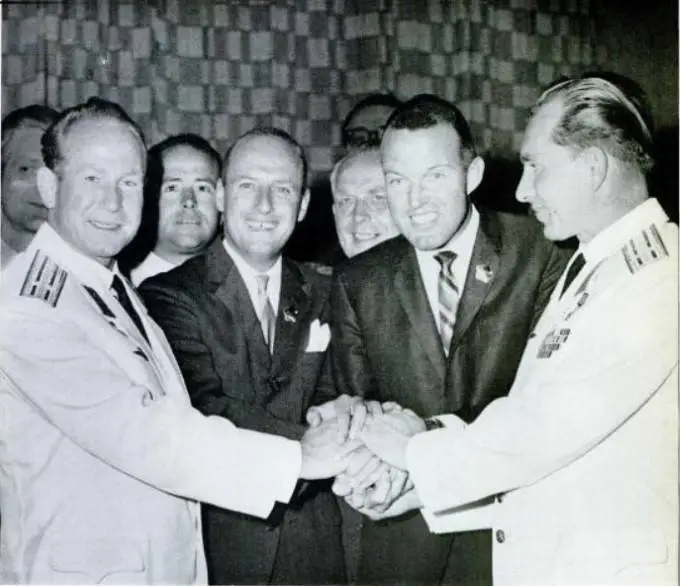
Cooper and Conrad were flown to the Kennedy Space Center for debriefings and medical check-ups the day after splashdown and arrived back home to Houston on September 2. On September 14, President Lyndon B. Johnson awarded the NASA Exceptional Service Medal to the two astronauts and Dr. Charles Berry, the astronauts' chief physician. From September 15 to September 28, Cooper and Conrad and their wives traveled to six countries on a goodwill tour, visiting Greece, Turkey, Ethiopia, the Malagasy Republic (now Madagascar), Kenya, and Nigeria, also stopping in the Canary Islands before returning to Texas. While attending the International Astronautical Congress in Athens, Greece, Cooper and Conrad met with Voskhod 2 cosmonauts Pavel Belyayev and Alexei Leonov, the latter of whom performed the first EVA in March 1965.
Gordon Cooper served as backup command pilot of Gemini 12, the final Gemini mission, in late 1966 and as backup commander of Apollo 10 in early 1969. The usual Apollo crew rotation placed him in the commander's seat for Apollo 13, but Director of Flight Crew Operations Deke Slayton replaced Cooper with Alan Shepard, who had recently returned to active flight status, due to the former's lax attitude towards training. In 1968, Cooper and Charles Buckley, the NASA chief of security at the Kennedy Space Center, entered the 24 Hours of Daytona (now called the Rolex 24 at Daytona), a 24-hour race held at the Daytona International Speedway in Daytona Beach, Florida (shoutout to my old home), but was ordered by NASA to withdraw due to the dangers of motorsports.
Cooper retired from both NASA and the Air Force in July 1970 with the rank of colonel and worked as a technical consultant for numerous companies, including the Walt Disney Company, and was inducted into the International Space Hall of Fame in 1981 and the U.S. Astronaut Hall of Fame in 1990. He passed away on October 4, 2004, at his home in Ventura, California, from heart failure at the age of 77. A portion of his ashes were launched into space twice, first in April 2007 onboard the sub-orbital UP Aerospace SpaceLoft XL sounding rocket, and second in May 2012 onboard the SpaceX COTS Demo Flight 2 [2].

Pete Conrad's space career, on the other hand, was just getting started. He served as backup command pilot of Gemini 8 and command pilot of Gemini 11 in 1966. He and pilot Richard Gordon set a human space apogee record of 853 miles (1,373 km) that remained unbroken for nearly 60 years (not counting the Apollo missions that broke free from Earth's orbit) [3]. Conrad was backup commander of Apollo 9 in spring 1969 and flew to the moon as commander of Apollo 12 that November, becoming the third and shortest (at around 5'6" or 1.68 m) person to walk on the moon. Conrad's final trip into space was as commander of Skylab 2, the first crew to visit America's first space station, Skylab. He retired from both the Navy and NASA in 1973 with the rank of captain and in his eleven years as an astronaut, set two human space records, walked on the moon, and spent four weeks on the nation's first space station. Conrad joined McDonnell Douglas in 1976 and was a consultant on the Delta Clipper Experimental reusable single-stage-to-orbit launch vehicle in the 1990s. He was inducted into the International Space Hall of Fame in 1982 and the U.S. Astronaut Hall of Fame in 1993. Pete Conrad passed away on July 8, 1999 at the age of 69 from internal injuries sustained in a motorcycle crash.
In a September 11, 1965 report to President Johnson, NASA Deputy Administrator Hugh Dryden said the following about Gemini 5: "The primary objective of the Gemini 5 mission was to demonstrate man's ability to function in the space environment for eight days and to qualify the spacecraft systems under these conditions. The adaptability of the human body was indicated by the performance of the astronauts. This has assured us of man's capability to travel to the moon and return."
Gemini 5 pushed the United States closer to landing men on the moon and overtook the stagnating Soviet manned space effort. The next Gemini mission would attempt to perform the first rendezvous between two vehicles in space, but not quite in a way anyone expected.

Author's note: Thanks for reading and be sure to check out my YouTube channel. If you like this content, please consider supporting my website by donating to my Ko-Fi. No bucks, no Buck Rogers.
[1] The USAF/NASA X-15 was reusable and the three vehicles flew a cumulative 199 times between 1959 and 1968. Gemini spacecraft 2 flew the suborbital Gemini 2 flight in 1965 and the suborbital Manned Orbiting Laboratory test flight in 1966. The spacecraft intended for use in MOL was called Gemini B. The next American spacecraft to be reused was Space Shuttle Columbia in 1981 and the next American reusable space capsule was Crew Dragon Endeavour in 2021 (its maiden flight was in 2020). All Space Shuttle orbiters and Crew Dragon spacecraft have flown multiple times each.
[2] COTS stands for Commercial Orbital Transportation Services and was a NASA program initiated to encourage the development of private launch vehicles and spacecraft for ISS resupply.
[3] The highest Earth orbit ever achieved by humans was carried out by Polaris Dawn in 2024 with an apogee of 870 miles (1,400 km).
Bibliography
Cooper, Gordon and Henderson, Bruce. Leap of Faith: An Astronaut's Journey Into the Unknown. Harper Collins, 2000.
Granath, Bob. "Gemini V: Paving the Way for Long Duration Spaceflight." NASA, 5 August 2015. https://www.nasa.gov/missions/gemini/gemini-v/gemini-v-paving-the-way-for-long-duration-spaceflight/
Hacker, Barton C. and Grimwood, James M. On the Shoulders of Titans: A History of Project Gemini. NASA, 1977. https://www.nasa.gov/wp-content/uploads/2023/03/sp-4203.pdf
"Lake Champlain II (CV-39)." Naval History and Heritage Command, 28 July 2015. https://www.history.navy.mil/research/histories/ship-histories/danfs/l/lake-champlain-ii.html
Lethbridge, Cliff. "Gemini 5 Fact Sheet." Spaceline.org. https://www.spaceline.org/united-states-manned-space-flight/gemini-mission-program-index/gemini-5-fact-sheet/
Sauer, Richard L. and Calley, David J. "Chapter 4: Potable Water Supply." NASA Johnson Space Center. https://ntrs.nasa.gov/api/citations/19760005605/downloads/19760005605.pdf
Uri, John. "55 Years Ago: Gemini 5 Sets a New Record." NASA, 28 August 2020. https://www.nasa.gov/history/55-years-ago-gemini-5-sets-a-new-record/
————————————
"Eight Days a Week" — written by Paul McCartney and John Lennon, performed by the Beatles for their album Beatles for Sale, 1964
This post was written entirely without the use of AI (sorry HAL).


Blue Talisman Ex Nihilo is another fragrance that stands out for people interested in contemporary luxury tom ford lost cherry dupe perfumes. Its distinctive identity makes it an appealing subject for fragrance discussions, especially among those who enjoy discovering less conventional scents.
Modern elevators are expected to provide more than basic movement between floors; they should also emphasize FUJI ELEVATOR passenger safety, comfort, accessibility, efficiency, and dependable operation.
House roof repairs are an important part of keeping a home safe, secure, and well maintained. Roof issues Office Cleaning Service can occur for various reasons, such as aging materials, harsh weather conditions, moisture, poor ventilation, or unexpected damage. Regular inspections and timely repairs can help prevent minor problems from becoming more serious and costly.
Finding the best roof replacement service involves more than simply choosing the lowest price. Property Roof Repair owners should consider experience, workmanship, material options, communication, warranties, and the company’s approach to customer service.
Tree debris removal is an important part of maintaining a clean and safe property after pruning, trimming, storm damage, or emergency tree services. Branches, logs, leaves, and other organic materials can quickly create clutter and may become obstacles around driveways, walkways, gardens, and outdoor areas.