


Docking & Danger: 5 Fun Facts About Gemini 8

Updated: May 27
☆ Check out Spaceflight Histories on YouTube ☆
March 16, 2026 was the 60th anniversary of Gemini 8, the sixth manned mission of the Gemini program and the first docking of two spacecraft in orbit. The mission's command pilot was rookie Neil A. Armstrong, a civilian from NASA's second class of astronauts, the New Nine. The pilot was David R. Scott, also a rookie, from NASA's third class of astronauts. Both Armstrong and Scott would later command missions to the moon. The crew's backup astronauts were Charles "Pete" Conrad and Richard F. Gordon, the future prime crew of Gemini 11. Let's look at five interesting facts about Gemini 8.


The first five of Project Gemini's ten manned missions were completed in 1965 and accomplished multi-person spaceflight, living and working in space, space food, EVA, long duration flight, and rendezvous. The second half of the program aimed to improve EVA and develop docking procedures, both crucial for lunar missions. Gemini 8's was to be an ambitious, three-day mission with the primary objectives of rendezvous and docking with the Agena Target Vehicle (ATV) and performing an extravehicular activity (EVA). On flight day 2, Scott would have executed a 2-hour EVA—much longer than Ed White's Gemini 4 EVA in June 1965. At the end of a 25-foot (8 m) tether, he would start by retrieving the S-9 Nuclear Emulsion experiment on the retro adapter (located directly behind his seat) and activate the S-10 Micrometeorite Cratering experiment on the Agena. S-9's purpose was to study cosmic radiation in orbit and S-10's purpose was to collect samples of micrometeoroids and return them uncontaminated by Earth's atmosphere.
He would then move to the rear of the spacecraft and don an Extravehicular Support Pack (backpack) with a 75-foot (23 m) tether and a hand-held maneuvering unit. Concurrently. Armstrong would have undocked from the Agena and flown 60 feet (18 m) away. Scott would use the maneuvering unit to translate to the end of his tether and Armstrong would fly the Gemini to retrieve him. Once Scott was back inside, Armstrong would re-dock with the ATV. On flight day 3, two more undocking and re-docking exercises as well as zodiacal light photography, a frog egg growth experiment, synoptic terrain photography, and cloud spectrophotography would have been carried out. Armstrong and Scott would splashdown in the western Atlantic Ocean and be retrieved by the USS Boxer (LPH-4).
This is not what happened.
1. Patch Me Through
Gemini 8's mission insignia is more abstract than those of previous flights, lacking both the Gemini spacecraft and the program's name spelled out. At the top are the stars Castor and Pollux, the two brightest stars in the Gemini constellation [1]. Their light is refracted through a prism and separated into the colors of the visible spectrum representing the spectrum of Project Gemini objectives the mission intended to fulfill. At the bottom are the zodiac symbol for the Gemini constellation and a Roman numeral "VIII" to depict the mission name.


2. First Man
Command pilot Neil Armstrong was the first American civilian to reach orbit and the fifth civilian in space after cosmonaut Valentina Tereshkova onboard Vostok 6 in June 1963, pilot Joe Walker onboard X-15 Flight 90 in July 1963, and cosmonauts Konstantin Feoktistov and Boris Yegorov onboard Voskhod 1 in October 1964. Armstrong served as a naval aviator in the United States Navy Reserve from 1949 to 1960, which included a tour onboard the USS Essex flying the Grumman F9F Panther during the Korean War. He then served as a test pilot for the National Advisory Committee for Aeronautics, the predecessor to NASA, and was selected by the US Air Force for its Man in Space Soonest project in June 1958. The program was canceled that August and Armstrong was assigned to the North American X-15 program in 1960, piloting the rocket-powered aircraft seven times. He was also selected for Boeing's X-20 Dyna-Soar spaceplane program in 1960 but left the X-15 and X-20 programs in mid-1962 to join NASA's Astronaut Corps as a member of its second group, the New Nine. Armstrong separated from the Naval Reserve in 1960. Elliot See, the original command pilot of Gemini 9 and one of Armstrong's New Nine classmates, was also a civilian and the two made up the backup crew of Gemini 5 with Armstrong as backup command pilot and See as backup pilot.

3. A Real Smoothie
Gemini 8 lifted off from Launch Complex 19 on Cape Kennedy on Wednesday, March 16, 1966 at 11:41 AM local time. The mission's ATV launched from LC-14 at 10:00 AM and entered into a 185 mile (298 km) circular orbit. The first ATV launched for docking with Gemini 6 in October 1965 but its Atlas launch vehicle failed. March 16, 1966 was also the 40th anniversary of the launch of the world's first liquid fueled rocket.
The Atlas carrying Gemini 8's Agena Target Vehicle launches from LC-14 (NASA ID: S66-24482) | Gemini 8 lifts off from LC-19 (NASA ID: KSC-66PC-0038)
Gemini 8 made radar contact with the Agena at a distance of 206 miles (331 km) and Armstrong and Scott made visual contact at a distance of 87 miles (140 km).
Rendezvous was achieved at 6 hours after liftoff and after nine maneuvers brought the capsule within 150 feet (45 m) of the Agena with zero relative motion between the two spacecraft. The astronauts inspected the ATV for damage during launch and after a 30-minute examination, they were given the go for docking. Armstrong crept towards the Agena at 3 inches (8 cm) per second. At 5:14 PM and during Gemini 8's fifth orbit, the first space docking was achieved. "Flight, we are docked," Armstrong radioed. "It was a real smoothie."

Scott commanded the Agena to roll the joined spacecraft 90 degrees. As the spacecraft drifted out of communications range with the ground, CAPCOM and Gemini 7 veteran Jim Lovell radioed, "If you run into trouble and the attitude control system in the Agena goes wild, just send in Command 400 to turn it off and take control with the spacecraft." For fifteen minutes, out of contact with the Manned Space Flight Network tracking station in Tananarive, Malagasy Republic (now Antananarivo, Madagascar) and before signal acquisition by the USNS Coastal Sentry Quebec tracking ship stationed southwest of Japan, Armstrong and Scott were alone over the Indian Ocean.

4. Bad Attitude
The Agena obeyed commands sent by both the ground and the Gemini spacecraft. Scott commanded the vehicle to turn the combined spacecraft 90 degrees to the right, but as he glanced at the instrument panel inside the cockpit, he noticed the attitude indicator showed a 30 degree roll. He said to his crewmate, "Neil, we're in a bank." Armstrong fired the Gemini's orbital attitude and maneuvering system (OAMS) thrusters while Scott turned off the Agena's thrusters to slow the roll, but both began moving yawing and rolling more violently. Armstrong noticed the Gemini's fuel supply had dropped to 30%—the malfunction must be with the Gemini rather than the Agena. Scott transferred control of the Agena back to the ground and Armstrong quickly undocked and backed away from the target vehicle.
Immediately, without the added mass of the Agena, the Gemini's tumbling got worse, reaching a roll rate of nearly one full rotation per second. If the astronauts kept spinning at this rate, they would lose their vision and lose consciousness. Armstrong shut down the OAMS thrusters and activated the Reentry Control System (RCS) thrusters located on the capsule's nose. This stabilized the spacecraft...

5. Your Flight has Been Terminated
...but used up almost 75% of the RCS fuel. Mission rules dictated that once the reentry system was activated, the flight had to be aborted. Further docking tests, Scott's EVA, and Gemini 8's science experiments and other objectives were scrapped. It was found later that OAMS thruster number 8 was stuck open, depleting the spacecraft's fuel supply and causing it to spin erratically.
Gemini 8 reentered during its seventh orbit and splashed down 1.6 miles (2.6 km) from its target in the west Pacific Ocean almost 500 miles (800 km) east of Okinawa. Total mission elapsed time was 10 hours, 41 minutes, and 26 seconds. The destroyer USS Leonard F. Mason sped to the splashdown point. Air Force pararescuers arrived on scene first and attached a floatation collar to the capsule. Three hours after splashdown, Armstrong and Scott and their Gemini capsule were safely onboard the Mason and the destroyer charged to Naha Port in Okinawa.

21 hours after splashdown, they arrived in Japan and were met by astronaut Wally Schirra, who was in Honolulu, Hawaii on a post-Gemini 6A goodwill tour while Gemini 8 was in orbit. The three took a limousine from the port to Kadena Air Force Base to fly back to Cape Kennedy, making a stop at Hickam Air Force Base in Honolulu on the way. They arrived at the Cape on March 19 for two days of debriefings. On March 26, Armstrong and Scott were awarded Exceptional Service Medals at the Manned Spacecraft Center (MSC) in Houston.

Honorable Mention: Anchors Aweigh
The USS Leonard F. Mason (DD-852) was a Gearing-class destroyer named in honor of Marine Corps Private First Class Leonard F. Mason, a posthumous Medal of Honor recipient for his sacrifice during the 1944 Battle of Guam. It was commissioned in June 1946 and spent two decades patrolling the western Pacific Ocean, including serving in the Korean War and participating in the 861-day-long siege of Wonsan, the longest naval blockade in modern history, serving in the second Arab-Israeli War (the Suez Crisis), and rescued Taiwanese survivors of the 1965 Battle of East Chongwu. After recovering Gemini 8 and its astronauts, the Mason participated in the Vietnam War and was sold to the Republic of China in 1978.
Gemini 8's capsule is now on display at the Neil Armstrong Air and Space Museum in his hometown of Wapakoneta, Ohio.
Armstrong and Scott on the deck of the Mason (NASA ID: S66-18609) | Gemini 8 capsule is hoisted aboard the Mason (NASA ID: S66-18613)
Post-Flight
Armstrong and his wife Janet, Gemini 8 backup pilot Dick Gordon and his wife Barbara, and MSC Deputy Director George Low visited nine Latin American countries—Colombia, Brazil, Ecuador, Peru, Bolivia, Uruguay, Argentina, Chile, and Panama—from October 7 to 31, 1966. The tour would have been earlier in the year but had to be pushed back until after Gordon's Gemini 11 flight in September.
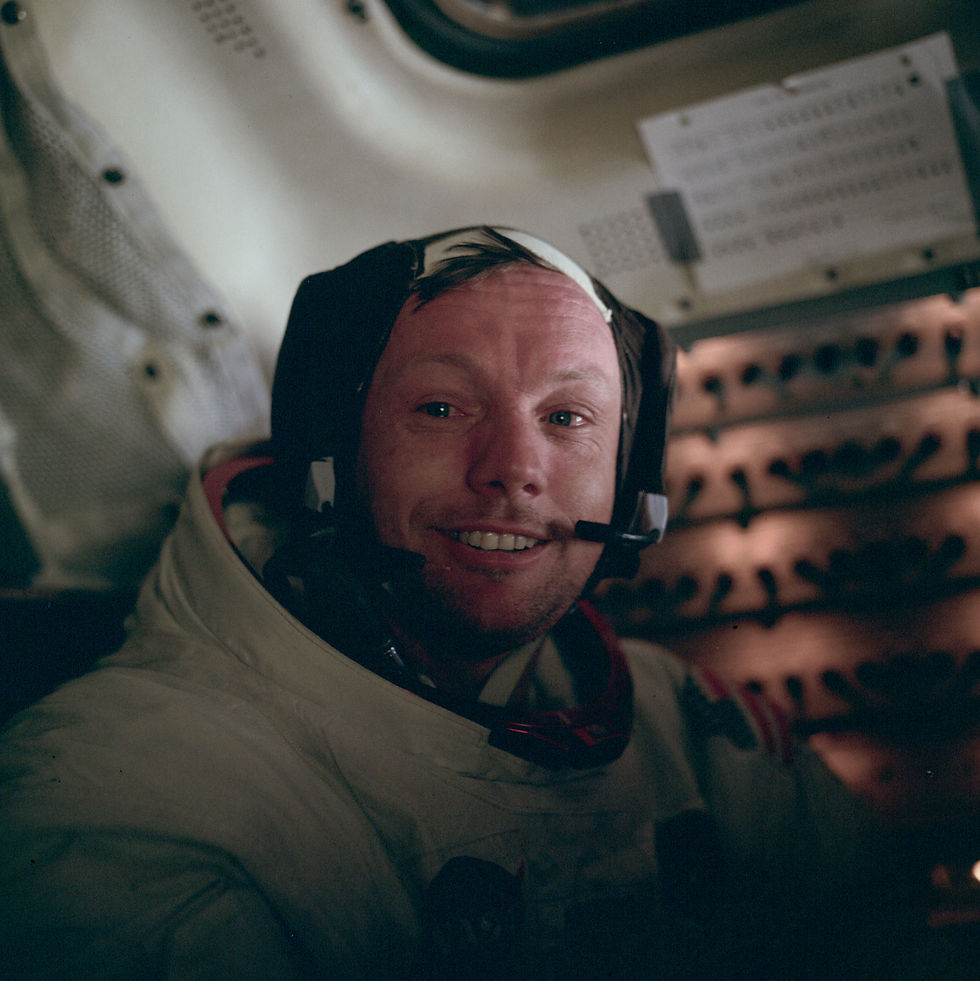
Neil Armstrong served as backup command pilot for Gemini 11 with rookie Bill Anders as backup pilot [2]. On January 27, 1967, Armstrong, Scott Carpenter, Gordon Cooper, Dick Gordon, and Jim Lovell were in Washington, D.C. for the signing of the Outer Space Treaty, the framework for all international space law. Armstrong, Michael Collins, and Buzz Aldrin made up the backup crew of Apollo 8. On December 23, 1968, while Apollo 8 cruised to the moon, Director of Flight Crew Operations Deke Slayton offered Armstrong command of Apollo 11, the anticipated first manned moon landing. The crew was confirmed in January 1969 and on July 16, the trio launched from the Kennedy Space Center on one of the most hazardous and dangerous and greatest adventures on which man has ever embarked. Armstrong and Aldrin touched down at the Sea of Tranquility on July 20 and spent 21 hours and 36 minutes on the surface.
Armstrong retired from NASA in 1971 and taught at the University of Cincinnati until 1980. He was the vice chairman of the Rogers Commission, the panel that investigated the Space Shuttle Challenger disaster, and served on the board of directors of several aerospace and engineering companies. He was inducted into the International Space Hall of Fame in 1976 and the US Astronaut Hall of Fame in 1993. Armstrong passed away at the age of 82 on August 25, 2012 from complications from coronary bypass surgery.

David Scott was assigned as backup senior pilot for Apollo 1 with Gemini 4 veteran Jim McDivitt and rookie Rusty Schweickart as commander and pilot, respectively. After the fire that claimed the lives of the Apollo 1 astronauts on January 27, 1967, Scott and his crewmates were reassigned as prime crew of Apollo 8 with the mission objective of testing the Apollo Command/Service Module and Lunar Module in low Earth orbit. This mission became Apollo 9 with Scott as command module pilot and Schweickart as lunar module pilot. In March 1969, Scott piloted CSM Gumdrop while LM Spider flew on its own and he performed a stand-up EVA.

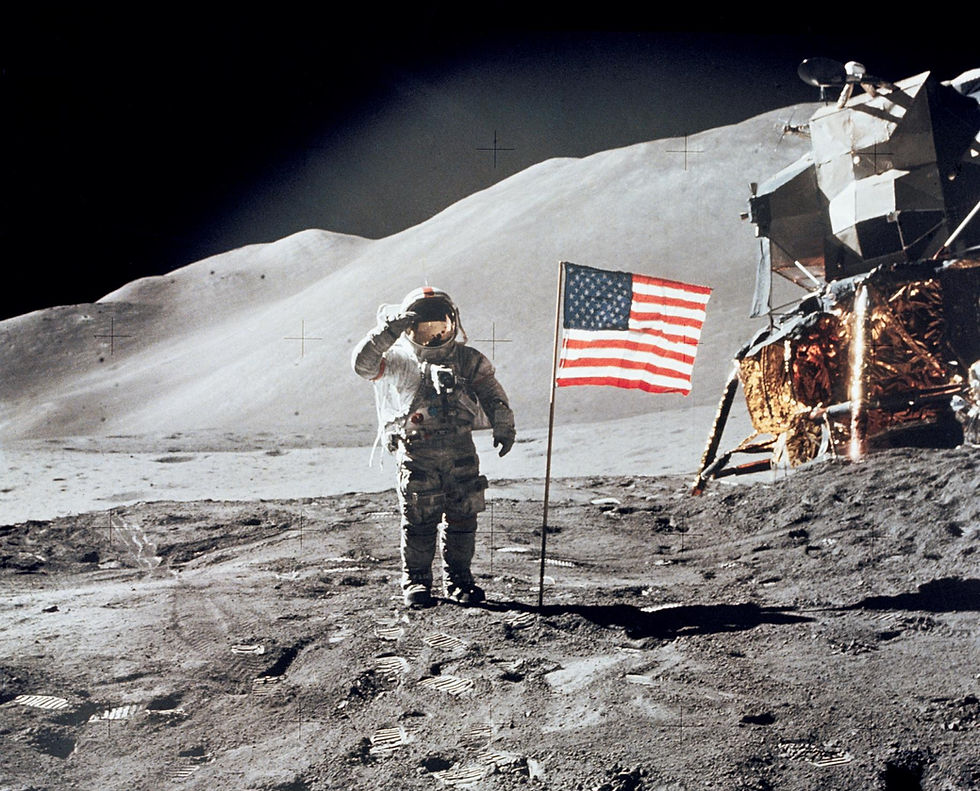
Scott was then assigned as backup commander of Apollo 12 and prime commander of Apollo 15, the fourth manned moon landing, with Al Worden as CMP and Jim Irwin as LMP. Scott and Irwin drove the Lunar Roving Vehicle around Hadley Rille on a geology-heavy mission in July and August of 1971. They also left behind a plaque bearing the names of fallen American and Soviet space explorers and a small aluminum sculpture called Fallen Astronaut. After Apollo 15, Scott served as a special assistant on the Apollo-Soyuz Test Project and in 1973, was appointed deputy director of NASA's Dryden Flight Research Center at Edwards AFB in California [3]. He retired from the US Air Force with the rank of colonel in March 1975 and retired from NASA in September 1977.
Like many early astronauts, Scott worked in the private sector following his NASA departure and was a consultant on the movies Apollo 13, In the Shadow of the Moon, and Magnificent Desolation and the HBO miniseries From the Earth to the Moon. He was inducted into the International Space Hall of Fame in 1982 and the US Astronaut Hall of Fame with fellow Gemini astronauts in 1993. As of 2026, Scott is one of only four surviving Apollo moonwalkers and six surviving Apollo astronauts.
Despite the mission abort following the near-disastrous stuck thruster, Gemini 8 did achieve its primary mission objective of rendezvous and docking with the Agena Target Vehicle. The Agena remained in orbit and served as a passive rendezvous target for Gemini 10 in July 1966. Pilot Mike Collins used the hand-held maneuvering unit to retrieve the micrometeorite collector on the vehicle's exterior. This was the only Gemini 8 science experiment to be completed. When the ATV fell back to Earth on September 15, 1967, it was the last piece of Gemini hardware to deorbit and reenter. Following Gemini 8, a "master switch was added to the Gemini spacecraft to make it possible for astronauts to turn off individual elements of a system not working properly" (Granath, 2016). The next mission, Gemini 9A, would attempt to do what Gemini 8 could not.

[1] The Gemini 6A, Gemini 10, and Gemini program insignia also depict Castor and Pollux.
[2] Anders became one of the first human beings to leave Earth's vicinity and fly to the moon as lunar module pilot of Apollo 8 in December 1968.
[3] Now the NASA Neil A. Armstrong Flight Research Center.
Bibliography
"David R. Scott." New Mexico Museum of Space History. https://nmspacemuseum.org/inductee/david-r-scott/
Dorr, Gene. "Gemini 8." Space Mission Patches. https://genedorr.com/patches/Gemini/Ge08.html
"Gemini 8 Press Kit." NASA, 11 March 1966. http://www.ccas.us/CCAS_NASA_PressKits/Gemini_Missions/Gemini8_Press_Kit.pdf
Granath, Bob. "Gemini's First Docking Turns to Wild Ride in Orbit." NASA, 3 March 2016. https://www.nasa.gov/missions/gemini/gemini-viii/geminis-first-docking-turns-to-wild-ride-in-orbit/
"Leonard F. Mason (DD-852)." Naval History and Heritage Command. https://www.history.navy.mil/research/histories/ship-histories/danfs/l/leonard-f-mason-dd-852.html
"Neil A. Armstrong." New Mexico Museum of Space History. https://nmspacemuseum.org/inductee/neil-a-armstrong/
Uri, John. "55 Years Ago: Gemini VIII, the First Docking in Space." NASA Johnson Space Center, 16 March 2021. https://www.nasa.gov/history/55-years-ago-gemini-viii-the-first-docking-in-space/
This post was written entirely without the use of AI (sorry HAL).


Comments