


Egg-straterrestrial Experiments: A Brief History of Birds in Space

Updated: May 27
☆ Rather watch a video than read all of this? Click here to be redirected to my birds in space YouTube video. ☆
Since the late 1940s, countries all over the world have sent all kinds of creatures and critters into the vast unknown, studying the physiological effects of microgravity, radiation, and high stress on living organisms. On July 9, 1946, a US Army-launched V-2 rocket carried the first living organisms, a jar of fruit flies, into space. The United States used different species of primates for space research and Albert II, a rhesus macaque, became the first mammal in space on June 14, 1949. More famous space monkeys include Miss Baker the squirrel monkey, the first primate to survive a trip to space and back in May 1959, and Ham the chimpanzee, the first hominid in space in January 1961.
The Soviet union used stray female dogs for space research and on July 22, 1951, Dezik and Tsygan became the first living creatures to survive spaceflight. The most famous space dog is Laika, a three-year-old mongrel who on November 3, 1957 became the first living creature to orbit the Earth onboard Sputnik 2. In August 1960, Belka and Strelka, as well as a gray rabbit, two rats, and 42 mice became the first living creatures to survive orbital spaceflight.
On October 18, 1963, France sent the first and only feline, a stray female tuxedo cat named Félicette on a suborbital flight. In September 1968, the Soviet Union sent the first living organisms to the moon, the largest of which were a pair of steppe tortoises. Five mice nicknamed Fe, Fi, Fo, Fum and Phooey flew to the moon and back with the Apollo 17 astronauts in December 1972. Skylab 3 in 1973 carried the first fish and spiders into space and bullfrogs and newts were flown in the 1970s and 80s. But no one really talks about the birds that made trips into space.


The Eagle and the Hawk
Birds have been symbols of manned space exploration since the beginning. The Soviet Vostok spacecraft, with the exception of Vostok 1 (Kedr or Cedar), used birds as callsigns: Vostok 2 was Oyrol (Eagle), Vostok 3 was Sokol (Falcon), Vostok 4 was Berkut (Golden Eagle), Vostok 5 was Yastreb (Hawk), and Vostok 6 was Chayka (Seagull) [1]. NASA's Gemini 4 astronauts wanted to call their capsule American Eagle and the Apollo 11 astronauts named their Lunar Module, one of the most famous spacecraft in history, Eagle after the national symbol of the United States. Since the 18th century, the bald eagle has been a symbol of courage, freedom, and strength and the birds are notable for their adaptability and resilience, trademark characteristics of astronauts. The Apollo 15 astronauts, all of whom served in the U.S. Air Force, named their mission's LM Falcon after the United States Air Force Academy mascot. The SpaceX Falcon rocket family's namesake should be obvious and Merlin, the engine family used by these rockets, is a species of falcon. Further, the Astrobotic Technology Peregrine Lunar Lander is also named after a species of falcon. As of February 2026, 21 crewed mission insignia feature birds.

Several Soviet and Russian spacesuits were also named after birds, starting with the pressure suit worn by the Voskhod 2 cosmonauts called Berkut. It protected Alexei Leonov during his historic first extravehicular activity (EVA) in March 1965. The Yastreb EVA suit was used only once during the crew exchange between Soyuz 4 and Soyuz 5. In January 1969, the pair performed the first successful docking of two manned spacecraft but they lacked a connecting tunnel for easy internal transfer between the capsules. Soyuz 4 launched with one cosmonaut while Soyuz 5 launched with three, and two of the Soyuz 5 cosmonauts performed an EVA to Soyuz 4. The Sokol spacesuit has been the standard flight suit for cosmonauts since 1973 and is still worn today and the Orlan (Sea-Eagle) has been the standard EVA suit since 1977 [2]. The Krechet (Gyrafalcon) lunar EVA suit and the Strizh (Swift) pressure suit meant to be worn by cosmonauts onboard Buran orbiters never flew in space.
The Egg Came First
The first avian experiment was performed by the Soviet Union in February 1979. Soyuz 32, crewed by cosmonauts Vladimir Lyakhov and Valery Ryumin, carried eight fertilized Japanese quail eggs to the Salyut 6 space station to study the impact of microgravity on the development of embryos and to determine whether a Japanese quail could hatch and grow in space, serving as a viable food source for cosmonauts on long-duration missions. According to the Almanac of Soviet Manned Space Flight by Dennis Newkirk, the space quails developed slower than the control group on Earth and had no heads.

From late September to mid October 1979, the Soviet Bion 5 spacecraft, also called Kosmos 1129, carried biological and radiation physics experiment packages from multiple countries, including the United States. In early 1971, the US and Soviet Union reached an agreement to cooperate in space biology and medicine. In May 1972, the "Agreement Concerning Cooperation in the Exploration and Use of Outer Space for Peaceful Purposes" was signed by the two superpowers and would ultimately culminate with the Apollo-Soyuz Test Project in 1975, the first international manned space mission. American payloads frequently flew on Soviet Bion spacecraft, a program that focused on space medicine that flew eleven missions from 1973 to 1996. The American Bion 5 payload included rats, quail embryos, and plants. The sixty Japanese quail eggs spent about two weeks orbiting Earth nestled in an incubator, but the shells of most broke upon landing.
Kosmos spacecraft on display at the Memorial Museum of Cosmonautics in Moscow
Kosmos spacecraft on display at the Memorial Museum of Cosmonautics in Moscow | Artist's rendering of a Kosmos spacecraft in orbit (NASA)

A Little Help from the Colonel
In the early 1980s, a high school student from Indiana named John Vellinger presented a science experiment studying how microgravity effected the development of chicken embryos at the Shuttle Student Involvement Program contest hosted by NASA and the National Science Teachers Association. He won at the national level and in 1985, when Vellinger was a freshman at Purdue University, NASA arranged for him to pitch his idea to the fast-food giant Kentucky Fried Chicken for financial sponsorship and development for spaceflight. The Chix in Space experiment consisted of 32 fertilized White Leghorn chicken eggs nestled in an incubator and was to orbit Earth onboard Space Shuttle Challenger and tended to by soon-to-be first teacher in space Christa McAuliffe. Chix in Space launched onboard STS-51L on January 28, 1986. Unfortunately, 73 seconds after liftoff, Space Shuttle Challenger broke apart and the lives of all seven astronauts and 32 chicken embryos were lost [3].

Fortunately for Vellinger, NASA and KFC were still interested in his experiment and he and his team reconstructed and refined the incubator that was lost. The new Chix in Space experiment consisted of 32 broiler hen eggs, half of which were fertilized and incubated nine days before launch and half of which were fertilized and incubated only two days before launch. STS-29 Discovery launched on March 13, 1989 and orbited Earth for five days. The experiment was carried out by pilot and fellow Purdue graduate John Blaha. A week after return, the first chick hatched. He was named Kentucky and was one of eight chicks who survived their trip to space and back. STS-47 Endeavour carried chicken embryos into space again in late 1992.

Peace of Chicken
Avian space experiments continued throughout the 1990s onboard Space Station Mir (Peace). On February 13, 1990, Soyuz TM-9 cosmonauts Anatoly Solovyev and Aleksandr Balandin arrived at Mir. Already onboard was an incubator for quail egg research. A Progress M-3 unmanned Soviet cargo spacecraft docked with the station on March 3 and delivered 33 fertilized quail eggs. 17 days later on March 22, the first healthy quail chick hatched onboard Mir and became the first bird in space and the first vertebrate to be born outside Earth's atmosphere. Eight chicks hatched in total and initially, the baby birds could not feed themselves because they could not latch onto anything in the microgravity environment. Solovyev and Balandin had to feed the chicks themselves. The ones that survived were later euthanized, preserved, and brought back to Earth so their physiology could be studied.

Soyuz TM-10 arrived to Mir on August 3, 1990 with two human and four avian passengers—cosmonauts Gennady Manakov and Gennady Strekalov brought along four adult quails, one male and three females. One of the females actually laid an egg en route to Mir and the egg was brought back to Earth when Soyuz TM-9 returned home on August 9 to finish incubation (Japanese quails have a typical incubation period of 17–18 days). And it hatched just fine. Back on Mir, the quails were equipped with little harnesses so they could feed themselves without human help, but they showed no interest in mating. They were brought back to Earth with the egg by Soyuz TM-9 and had trouble re-adjusting to gravity. One of the hens later mated with a non-space quail and laid eggs and the chicks that hatched were healthy [4].
But then the Soviet Union dissolved and space exploration changed. The Soviets, and as of December 26, 1991, the Russians, had Space Station Mir, the world's first modular space station, with plans for a successor, Mir-2. Mir operated in low Earth orbit from 1986 to 2001. The United States had plans for a modular space station of its own called Freedom. It would have been a collaborative project between NASA, the Canadian Space Agency, the European Space Agency, and the National Space Development Agency of Japan. With severe budget restrictions jeopardizing both stations, and the Soviet Union no longer existing, the U.S. and Russia announced plans for a new space station, an international space station, in 1993. To prepare American astronauts for long-duration space expeditions and to get NASA and the Russian Space Agency used to working together was the Shuttle-Mir program. Seven American astronauts carried out long-duration expeditions on Mir and nine Space Shuttle dockings rotated crew and cargo.

Dr. Norman Thagard became the first American to launch onboard a Russian Soyuz (Soyuz TM-21) and the first American to visit Mir in March 1995 as a crew member of Mir 18. On April 11, the Progress M-27 cargo resupply vehicle brought 48 fertilized Japanese quail eggs that were incubated in the onboard Bulgarian-built Quail Incubator. Thagard became the first American to handle quail eggs in space. The embryos were preserved during different stages of development and brought back to Earth by STS-71 Atlantis, the first Shuttle–Mir docking mission. Multiple batches of egg were delivered to and retrieved from the station from 1995 to early 1999. Dr. Shannon Lucid spent almost six months on Mir in 1996 as a crew member of Mir 21 and continued quail embryogenesis experiments. The Shuttle-Mir program ended in June 1998 and the first component of the International Space Station, the Russian Orbital Segment module Zarya, was put into orbit in November 1998. While American astronauts no longer visited Mir, the station continued crewed operations until 2000.
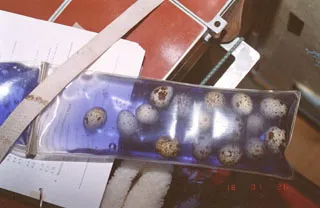

One of the last people to spend time on the station was Ivan Bella, the first Slovak citizen to fly in space [5]. He arrived to Mir on Soyuz TM-29 with commander Viktor Afanasyev and flight engineer Jean-Pierre Haigneré, who would both be spending six months on the station, on February 22, 1999. Bella's mission was called Štefánik after Milan Štefánik, a Slovak astronomer, aviator, diplomat, and politician who served as Czechoslovakia's 1st Minister of War and as a general in the French Army during World War I [6]. Bella's Slovakian experiment Prepelica SK-6 continued research of Japanese quail embryogenesis ("prepelica" is the Slovak word for "quail"). Sixty eggs completed two-thirds of the incubation process on Earth and Bella transferred them to the upgraded incubator waiting on Mir, Incubator-T, crushing four of them in the process. A few days later, the first of 36 total chicks hatched. They had to be hand-fed and unfortunately, the centrifuge broke down and the baby birds suffered in the cold darkness. Ten chicks returned to Earth with Ivan Bella and commander Gennady Padalka onboard Soyuz TM-28 on February 28, 1999, but only three survived descent. The next mission, Soyuz TM-30 in spring 2000, was the final crewed mission to Mir and in March 2001, the then-largest artificial satellite reentered over the South Pacific Ocean.
Overall, the Japanese quail embryos and chicks onboard space station Mir had a lower hatching rate and a higher rate of anomalies, such as abnormalities in the eyes, beak, and spine, when compared to control groups on Earth, though there were no significant deviations of body size and weight. This research paper discusses the early development of vertebrates in space, including the space quails.
Swan Song
American experience with quail embryogenesis on Mir was harnessed for the development of the Avian Development Facility (ADF), "a habitat designed to provide environmental conditions optimized to study avian development in the microgravity of spaceflight" (NASA). a It made its maiden flight onboard STS-108 Endeavour in December 2001 and was designed by John Vellinger and Mark Desuer of Techshot Inc. (previously SHOT), the minds behind the Chix in Space experiment from the 1980s. The incubator contained two independently operated carousel platforms and the egg holders on each could rotate a full 360 degrees to simulate the natural turning of eggs on Earth by hens. The interior humidity, temperature, and oxygen levels were pre-programmable. 36 fertilized Japanese quail eggs orbited Earth with the STS-108 astronauts—18 on a stationary carousel for microgravity exposure and the other 18 on a spinning carousel that simulated a 1G environment. Two quail embryo experiments were conducted to study how microgravity impacts skeletal development and vestibular system development. The ADF's primary objective was the validation of its subsystems and it performed nominally.

As far as I have been able to find, STS-108's Avian Development Facility is the most recent avian space experiment, but there are a few more examples of birds and spaceflight to cover. In May 1995, while Space Shuttle Discovery sat on the launch pad ahead of the launch of STS-70 targeted for June, pad workers noticed about 200 holes in the orange external fuel tank's insulation foam ranging from little pecks to holes about 4 inches (10 cm) in diameter to claw marks. The culprit? Northern Flicker woodpeckers. The Kennedy Space Center sits on the 140,000 acre Merritt Island National Wildlife Refuge, home to hundreds of species of amphibians, birds, fish, mammals, and reptiles, including the Northern Flicker woodpecker. STS-70 was delayed until July and the stack rolled back to the Vehicle Assembly Building in early June for repairs. Discovery launched on July 13, 1995 and deployed the Tracking and Data Relay Satellite-7.
Woodpecker holes in the external fuel tank (NASA) | Alternate STS-70 patch with Woody Woodpecker to "pay homage" to the troublesome birds (via spacepatches.nl)
Kentucky Fried Chicken left Earth once more in June 2017 when a World View Enterprises' Stratollite high-altitude balloon carried a Zinger, a spicy crispy chicken sandwich, into the stratosphere. While the Zinger 1 mission was a more significant marketing campaign for KFC than Chix in Space was, it was also a technology demonstrator of the new high-altitude helium balloon developed and used for communications, meteorology, and remote sensing.
For now, this seems to be the end of the birds in space story. There is limited room onboard the International Space Station for biological experiments and rules for sending living creatures into space have gotten more strict over the decades. The Japanese quail experiments carried out by Space Station Mir's cosmonauts indicated the birds would likely not serve as a viable food source for space travelers during long-duration expeditions since they had no interest in mating, trouble feeding, and the eggs had a lower hatching rate and higher abnormality rate. But it was also onboard the station that the first vertebrate was born outside Earth's atmosphere. While Kentucky the space chicken and Mir's quails did not reach near the popularity that Laika, Ham, and Félicette have decades after their fateful trips into space, the avian space travelers contributed to our understanding of how new life adapts to microgravity and are trailblazers in their own small, unique way.
Kentucky Fried Chicken’s Challenger Chix in Space press release said it best: “When people begin living in space, they’ll never ponder the age-old question of which came first, the chicken or the egg. In space, the answer will be, ‘The egg.’”

[1] I've seen Gagarin's Vostok 1 referred to as Lastochka (Swallow) in American publications.
[2] The Sokol suit was developed as a response to the loss of the Soyuz 11 cosmonauts. From Soyuz 1 in 1967 to Soyuz 11 (except Soyuz 4 and Soyuz 5), the cosmonauts did not wear pressure suits during launch and reentry. Soyuz 11 cosmonauts Georgy Dobrovolsky, Vladislav Volkov, and Viktor Patsayev were killed from asphyxiation during reentry on June 29, 1971.
[3] In the mid-1980s, NASA initiated the Space Flight Participant Program with the goal of sending non-government employees (teachers, journalists, other creatives, etc.) into space to increase public awareness of space exploration. One individual in particular NASA was interested in having orbit the Earth on Space Shuttle Challenger was Caroll Spinney, the actor and puppeteer who played Big Bird (and Oscar the Grouch) on Sesame Street. To be brief, NASA proposed sending Spinney as Big Bird into space to get kids interested in space and science, but since the Big Bird costume was 8'2"—too large to fit in the orbiter's crew cabin—these potential plans were dropped and the Space Flight Participant Program was terminated shortly after the Challenger disaster.
[4] This was not the first time an animal that had flown in space had offspring: In 1960, Soviet dogs Belka and Strelka became the first living creatures to survive orbital spaceflight. Strelka had six puppies with a male ground-based space experiment dog named Pushok and one of their puppies, Pushinka, was gifted to President John F. Kennedy by Premier Nikita Khrushchev. All of the space dogs were female so it's possible others had puppies before Strelka, but the records of these dogs, their flights, and what happened to the ones that survived are incomplete.
[5] Czechoslovakia split into Czechia and Slovakia on December 31, 1992. Vladimír Remek became the first and only Czechoslovak (and the first non-American and non-Soviet citizen) in space in 1978.
[6] Some international cosmonauts' missions had their own unique names. In fact, Haigneré's long-duration mission was called Perseus.
Further reading
Avilla, Aeryn. "Return to Sender: Post-Challenger Canceled Space Shuttle Missions." Spaceflight Histories, July 12, 2023. https://www.spaceflighthistories.com/post/cancelled-shuttle
Brennan, Anna Marie. "We've Been Sending Animals Into Space for 7 Decades – Yet There are Still No Rules to Protect Them From Harm." University of Waikato, August 20, 2025. https://www.waikato.ac.nz/int/news-events/news/weve-been-sending-animals-into-space-for-7-decades-yet-there-are-still-no-rules-to-protect-them-from-harm/
Proshchina, Alexandra et al. "Reproduction and the Early Development of Vertebrates in Space: Problems, Results, Opportunities." Life via National Library of Medicine, January 31, 2021. https://pmc.ncbi.nlm.nih.gov/articles/PMC7911118/
Bibliography
Boyle, Alan. "NASA Confirms Talks to Fly Big Bird on Doomed Shuttle Challenger." NBC News, 4 May 2015. https://www.nbcnews.com/science/weird-science/nasa-confirms-talks-fly-big-bird-doomed-shuttle-challenger-n353521
Cofield, Calla. "Chicken Sandwich Takes One Giant Leap for Food-Kind." Space.com, 29 June 2017. https://www.space.com/37339-chicken-sandwich-makes-stratospheric-balloon-flight.html
"Commercial Biomedical Testing Module (CBTM)." NASA. https://osdr.nasa.gov/bio/repo/data/payloads/CBTM
Evans, Ben. "Woodpecker Attack: Remembering STS-70, 25 Years On." AmericaSpace, 29 May 2020. https://www.americaspace.com/2020/05/29/woodpecker-attack-remembering-sts-70-25-years-on/
Gray, Tara. "A Brief History of Animals in Space." NASA, 18 January 1998. https://www.nasa.gov/history/a-brief-history-of-animals-in-space/
"Habitats: Avian Development Facility Developed by SHOT, Inc." NASA Space Station Biological Research Project. https://web.archive.org/web/20050829070146/http://brp.arc.nasa.gov/GBL/Habitats/adf.html a
LePage, Andrew. "Soyuz 4 & 5: The First Crew Exchange in Space." Drew ex machina, 17 January 2019. https://www.drewexmachina.com/2019/01/17/soyuz-4-5-the-first-crew-exchange-in-space/
Newkirk, Dennis. Almanac of Soviet Manned Space Flight. Gulf Publishing Company, 1990. ISBN 0-87201-848-2. Accessed via https://archive.org/details/almanacofsovietm0000newk/mode/2up
Nikitin, S. A. "The Kosmos-1129 Biosatellite." NASA Technical Memorandum. NASA, August 1980. https://ntrs.nasa.gov/api/citations/19810006496/downloads/19810006496.pdf
Pike, Jared and Giles, Nicole Elizabeth. “John Vellinger: From Chix in Space to a Company in Space.” Purdue University, 28 September 2018. https://www.purdue.edu/space/john-vellinger-from-chix-in-space-to-a-company-in-space/
Uri, John. "50 Years Ago: The United States and the Soviet Union Sign a Space Cooperation Agreement." NASA Johnson Space Center, 23 May 2022. https://www.nasa.gov/history/50-years-ago-the-united-states-and-the-soviet-union-sign-a-space-cooperation-agreement/
van den Berg, Chris. "Mir News 457: Soyuz-TM28." Encyclopedia Astronautica. http://www.astronautix.com/s/soyuztm-29.html
Vellinger, John et al. "Engineering Support of Microgravity Life Science Research: Development of an Avian Development Facility." American Institute of Aeronautics and Astronautics, April 1995. https://ntrs.nasa.gov/api/citations/19970004930/downloads/19970004930.pdf
—————————————
"The Eagle and the Hawk" — written and performed by John Denver from the album Aerie, 1971.
This post was written entirely without the use of AI (sorry HAL). Congrats to my Olympic Cats for bringing home the gold (and silver and bronze). I'll never get tired of hearing "Free Bird".


Comments